 I've seen barns that protect and harbor life, and barns that rehabilitate
and nurture life back. And on this day, when the deadness of winter was taking
center stage, my thoughts and my truck turned down a frost-covered dirt road
that led to a barn where life is created. I parked in front of the Premier
Breeding barn, grabbed my camera, and my notebook,
and prepared to give birth to a new chapter in my search for the perfect barn.
I've seen barns that protect and harbor life, and barns that rehabilitate
and nurture life back. And on this day, when the deadness of winter was taking
center stage, my thoughts and my truck turned down a frost-covered dirt road
that led to a barn where life is created. I parked in front of the Premier
Breeding barn, grabbed my camera, and my notebook,
and prepared to give birth to a new chapter in my search for the perfect barn.
The breeding barn and facility is framed by the prominent Turtle Rock, a ridge that was thrust up during the birth of the Rocky Mountains. A commitment to reproductive excellence and care of the horse was the vision of this breeding facility. Recognizing that there was a need in the horse industry for a place to stand stallions, builders joined with Brad Ray to create the breeding facility.
 Most breeding barns are retrofit to create a reproductive environment for
the horse, but the builders and Brad designed this facility, exclusively
for breeding, from the ground up.
Most breeding barns are retrofit to create a reproductive environment for
the horse, but the builders and Brad designed this facility, exclusively
for breeding, from the ground up.
The critical elements in a successful breeding barn are centered around stress, or rather, the lack of it. The horses must be comfortable in a stress free environment. This also extends to the staff and the public. If everyone is comfortable, stress levels stay low. I can't think of a better stress reliever than to be surrounded by foals. The theory must work because the conception rate in this barn is high at about 95%.
 Like many barn designers, the builders and Brad took the best concepts from
the many barns that they have worked in and been around, and produced a final
design using all of those elements. "The builders allowed me to design
a barn that didn't spare anything when it comes to the care of the horse,"
stated Ray. The end result is a safe, spacious, clean, airy barn, which flows
with efficiency.
Like many barn designers, the builders and Brad took the best concepts from
the many barns that they have worked in and been around, and produced a final
design using all of those elements. "The builders allowed me to design
a barn that didn't spare anything when it comes to the care of the horse,"
stated Ray. The end result is a safe, spacious, clean, airy barn, which flows
with efficiency.
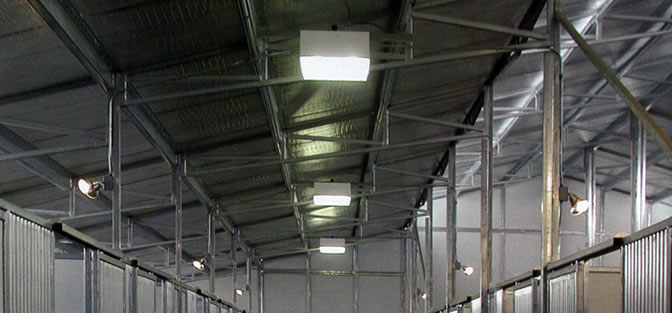
The 21,000 sq. ft. barn houses a mare stall wing, mare reproduction area, stallion collection room, laboratory, reception office, foal watching rooms and foaling stalls, a lounge, the stallion wing, and a wash rack. The barn can accommodate 10 stallions in the west wing, and 40 mares in the two east wings. The reproductive area is the centerpiece of the barn, and is designed to provide easy access to horses, and to easily keep an eye on the foaling stalls.
Double aisles were designed to provide visibility across the entire barn from either aisle.
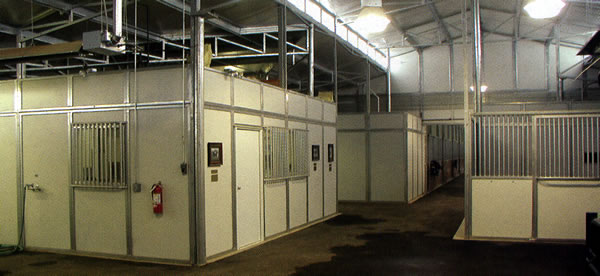 The stallion stalls are a roomy 12'x20', with 12' dividing walls to avoid contact
with neighboring stallions. Each stall has a turnout run, and the stallions
are turned out in every other run, to once again, keep the boys from fighting
over the girls. The stallions are kept at the opposite end of the barn from
the mares, to minimize stimulation and breeding stress. Dividing doors can be
closed to isolate them from the mares. The mare stalls are 12'xl4' with turnout
runs, and flood lighting on a timer system for optimum photoperiod. By having
the lights on 16 hours a day, the mare's reproductive system is tricked into
thinking it's spring, and this in turn brings them into heat. This allows breeding
to take place in February instead of late March, and also maintains a short
coat length. The foaling stalls are 12'xl6' with closed circuit monitoring to
the foal watching rooms and the laboratory. Plexiglas windows in each stall
allow direct undisturbed viewing. Overhead radiant heat keeps the babies warm,
and the positioning of the stalls, in the center of the barn across from the
lab, provide unhindered viewing at all times. All stalls in the barn are rubber
matted and bedded with straw.
The stallion stalls are a roomy 12'x20', with 12' dividing walls to avoid contact
with neighboring stallions. Each stall has a turnout run, and the stallions
are turned out in every other run, to once again, keep the boys from fighting
over the girls. The stallions are kept at the opposite end of the barn from
the mares, to minimize stimulation and breeding stress. Dividing doors can be
closed to isolate them from the mares. The mare stalls are 12'xl4' with turnout
runs, and flood lighting on a timer system for optimum photoperiod. By having
the lights on 16 hours a day, the mare's reproductive system is tricked into
thinking it's spring, and this in turn brings them into heat. This allows breeding
to take place in February instead of late March, and also maintains a short
coat length. The foaling stalls are 12'xl6' with closed circuit monitoring to
the foal watching rooms and the laboratory. Plexiglas windows in each stall
allow direct undisturbed viewing. Overhead radiant heat keeps the babies warm,
and the positioning of the stalls, in the center of the barn across from the
lab, provide unhindered viewing at all times. All stalls in the barn are rubber
matted and bedded with straw.
 |
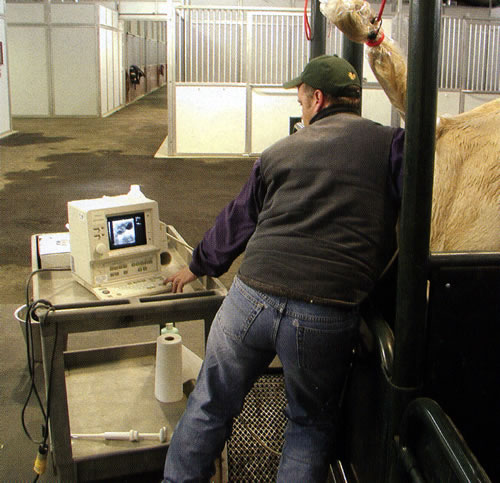 |
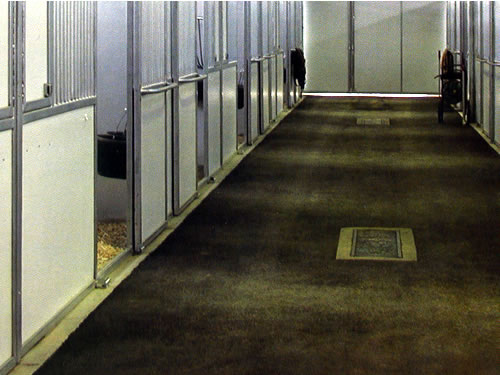
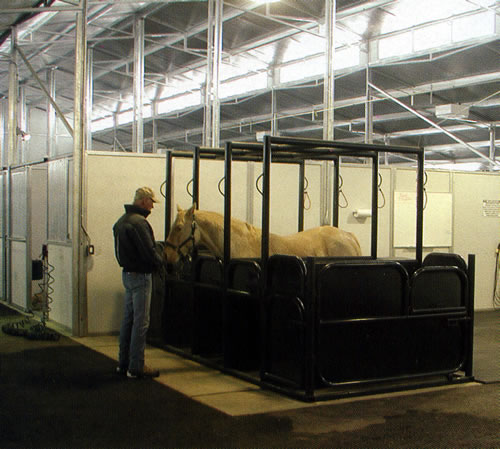
Large open areas throughout the barn provide for safe movement of the horses. The 12 ft. aisles are paved with asphalt for traction and ease of cleaning, with drains throughout. The mare evaluation area is equipped with stocks for safe palpitation and ultra-sounding, with safe areas at the sides for the foals, creating low stress levels for both mare and foals. My stress level was rising rapidly as Brad brought in a mare for an ultra sound examination. It was really quite amazing to watch as Brad's arm disappeared into the mare's rectum with the ultra sound device. I watched the monitor as the internal workings of the mare's reproductive system appeared on the screen. I glanced up at Brad to see him shoulder deep in the mare, and 11 started to wince thinking about the colonoscopy that I would need when I turned fifty in a couple of years. The mare however, remained calm and the exam was soon over.
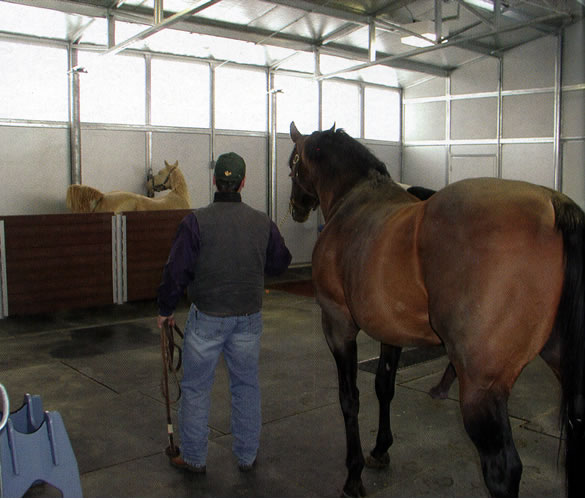 The reproduction area of the barn is state of the art with a highly qualified
and experienced staff, as well as an attending veterinarian. The stallion
collection room is large with plenty of natural light, and is shielded from
the main barn by the lab and a pair of sliding doors. This allows the stallions
to enter the collection room without causing undue excitement and stress to
the mare wing. The walls and floors can be easily hosed down and cleaned with
good drainage. The phantom (the mount) and the tease rail can be easily cleaned
as well. As a matter of fact, there isn't an area of the barn that can't be
thoroughly cleaned, with hot and cold-water hydrants every 25ft. Clients can
observe the collection safely from the viewing window in the lab. The proximity
of the collection room allows immediate access to the lab after collection.
The reproduction area of the barn is state of the art with a highly qualified
and experienced staff, as well as an attending veterinarian. The stallion
collection room is large with plenty of natural light, and is shielded from
the main barn by the lab and a pair of sliding doors. This allows the stallions
to enter the collection room without causing undue excitement and stress to
the mare wing. The walls and floors can be easily hosed down and cleaned with
good drainage. The phantom (the mount) and the tease rail can be easily cleaned
as well. As a matter of fact, there isn't an area of the barn that can't be
thoroughly cleaned, with hot and cold-water hydrants every 25ft. Clients can
observe the collection safely from the viewing window in the lab. The proximity
of the collection room allows immediate access to the lab after collection.
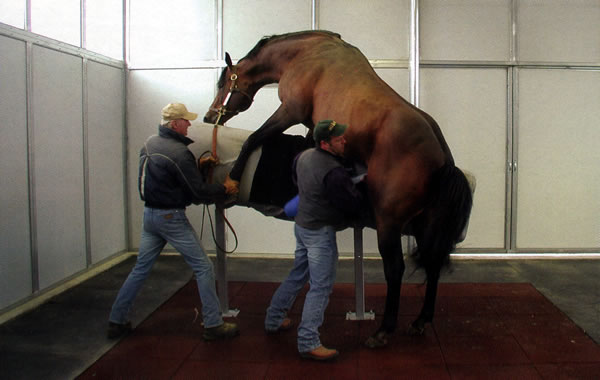
A mare was brought into the collection room and safely put behind the tease rail a few feet away from the phantom. There is nothing more electric than the grand entrance of a stallion that knows what awaits him. Brad brought in the snorting stud and I watched as he saw the mare, arched his neck, and reared in full testosterone glory. It is really an awesome sight to see an excited stallion, and a bit humbling, if you men know what I mean. With the help of staff member Don MacCurdy, Brad got the stallion onto the phantom, and in a matter of seconds the prized semen was safely contained in the artificial vagina, and the spent horse slid off the phantom as meek as a lamb. Regardless of species, a male is a male is a male, I thought, smiling. Brad returned the stallion and we went into the lab.
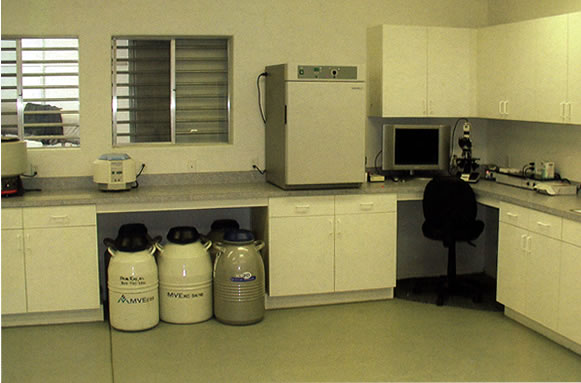 The lab features the latest in cutting edge equipment for semen collection,
evaluation, storage, handling and shipping. Clients can even view the collected
semen on a flat screen that is connected to the microscope. Now that's what
I call "must see TV!" From the lab one can observe the foaling stalls,
the collection room and the mare evaluation area. The lab is the axis of the
barn layout.
The lab features the latest in cutting edge equipment for semen collection,
evaluation, storage, handling and shipping. Clients can even view the collected
semen on a flat screen that is connected to the microscope. Now that's what
I call "must see TV!" From the lab one can observe the foaling stalls,
the collection room and the mare evaluation area. The lab is the axis of the
barn layout.
Plenty of fresh air and turnout is one of the keys to keeping horses happy, healthy, and stress free. The barn is oriented to allow for maximum light and ventilation during the spring and summer. Safe, flexible, PVC fencing isused on all of the turnout paddocks and posts are centered at 5 ft. for strength. To avoid disputes between neighbors, there are no common fence lines in the mare turnouts. Seven of the turnouts have a round layout to encourage movement and exercise. The footing is a special mulch footing for mares and foals that is soft and contains no sand. Foals can get sand colic from nibbling on footing that contains sand. Once again, safety has been taken into account and every scenario has been anticipated and planned for. The outdoor runs are well lit and are readily visible to the staff. There are twelve shed row mare stalls for owners who prefer their mares to be in more open accommodations. All horses are brought in at night except for those on shed row. The round pens create a striking concentric picture on the landscape of the farm, and the sight of frolicking foals makes for a lasting memory.
 For now the barn was quiet, with a fresh blanket of sparkling snow muffling
the sounds of nature. Soon enough, an early spring would come, brought on
by lights on timers and advanced technology, tricking Mother Nature into jump-starting
fertility. And while giving birth is inherent with risk, the mares that would
bring wet, wobbly, new foals into the world would do so in the safest conditions
possible at this barn. I stood on a hill overlooking the farm and felt the
warmth of the sun on my face and the chill of the air in my lungs. And I knew
the quiet of winter would soon give way to the nickering of contented nursing
foals, and the snorting of contented mares. And the air will occasionally
resonate with the screeching bugle of the mighty stallions, which are not
content as long as there are mares nearby. And the cycle of life will continue,
as it always has, within the perfection of nature, of the universe, and us.
For now the barn was quiet, with a fresh blanket of sparkling snow muffling
the sounds of nature. Soon enough, an early spring would come, brought on
by lights on timers and advanced technology, tricking Mother Nature into jump-starting
fertility. And while giving birth is inherent with risk, the mares that would
bring wet, wobbly, new foals into the world would do so in the safest conditions
possible at this barn. I stood on a hill overlooking the farm and felt the
warmth of the sun on my face and the chill of the air in my lungs. And I knew
the quiet of winter would soon give way to the nickering of contented nursing
foals, and the snorting of contented mares. And the air will occasionally
resonate with the screeching bugle of the mighty stallions, which are not
content as long as there are mares nearby. And the cycle of life will continue,
as it always has, within the perfection of nature, of the universe, and us.
Text and Photos Copyright 2005 by Horse Connection Magazine